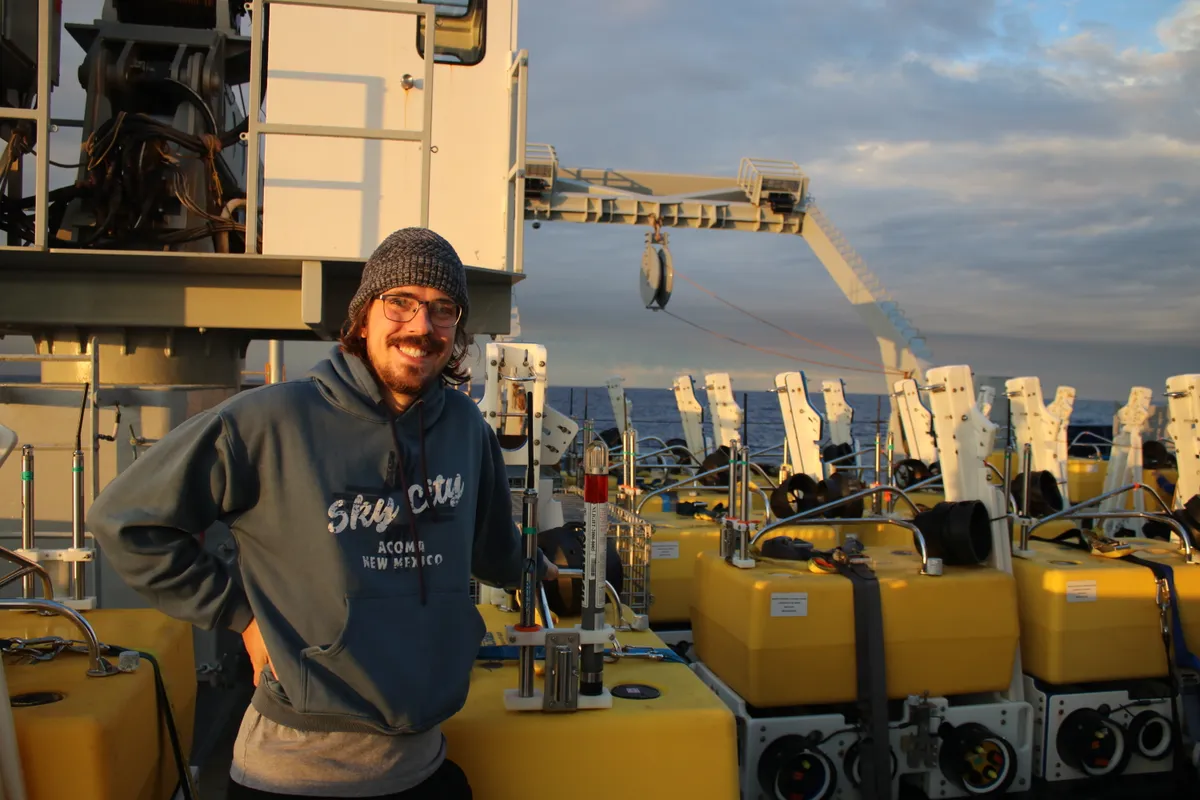
Seismic records from two parts of the Pacific Ocean show that the mantle beneath the Pacific plate is shaped by more than one process. Dr. Joey Phillips and his co-authors found that the rigid plate preserves clues from its formation, while the softer mantle beneath it responds to the plate’s present motion and to deeper internal flow.
That distinction matters because large global seismic models can smooth over the smaller-scale differences that reveal how oceanic plates form and evolve. “Global and regional observations are complementary rather than competing,” Dr. Phillips wrote. “Global models provide the large-scale framework, while dense ocean-bottom arrays allow us to examine the smaller-scale processes that produce deviations from that framework.”
The study compares two ocean-bottom seismometer arrays from the Pacific OBS Research into Convecting Asthenosphere, or ORCA, experiment. Young ORCA sits on seafloor about 43 million years old. There, the seismic fabric in the lithosphere is relatively strong and generally follows the direction in which the seafloor spread at the mid-ocean ridge. That pattern is consistent with a mineral alignment formed as mantle flowed beneath the ridge and was then locked into the new plate.
Old ORCA, on much older seafloor, tells a less simple story. Its lithospheric anisotropy is weaker, and its fast direction is rotated about 30 degrees from the inferred fossil spreading direction. Comparing the sites shows that age alone cannot explain the structure of Pacific lithosphere. Ridge movements and other changes during plate formation can leave different signatures, even far from an active plate boundary.
To investigate those signatures, the researchers combined recordings from ocean-bottom seismometers with Rayleigh- and Love-wave measurements covering periods from about five to 150 seconds. Because each period samples a broad depth range, the team tested models that extended from the crust to roughly 300 kilometers below the seafloor. They compared smoothly varying and layered models and evaluated uncertainty to distinguish features required by the data from those produced by modeling choices.
The shallow asthenosphere, the weaker layer beneath the rigid lithosphere, showed strong anisotropy broadly aligned with present-day Pacific plate motion at both sites. Dr. Phillips and his co-authors interpret that pattern as evidence that the moving plate shears the asthenosphere. Below about 200 kilometers, however, the anisotropy weakens and rotates away from plate motion. Pressure-driven lateral flow and buoyancy-driven convection may become more important there.
“The overall story is that the lithosphere preserves past deformation, the shallow asthenosphere is strongly influenced by present plate motion, and the deeper asthenosphere records independent convective flow,” Dr. Phillips wrote.
Dr. Phillips said his training and collaboration with James Gaherty and the broader NAU research group helped him connect detailed surface-wave observations and seismic inversions to questions about geodynamics. The project brought together ocean-bottom seismology, mantle dynamics, tomography and plate tectonics. That combination was important because anisotropy does not point to one process by itself. Its meaning emerges by comparing seismic observations with plate history, mantle velocity, attenuation and convection.
For Dr. Phillips, the regional variations are not a problem for global models. They are the reason to use both scales of observation. Broad models show the framework, while dense local arrays reveal the processes hidden inside it.