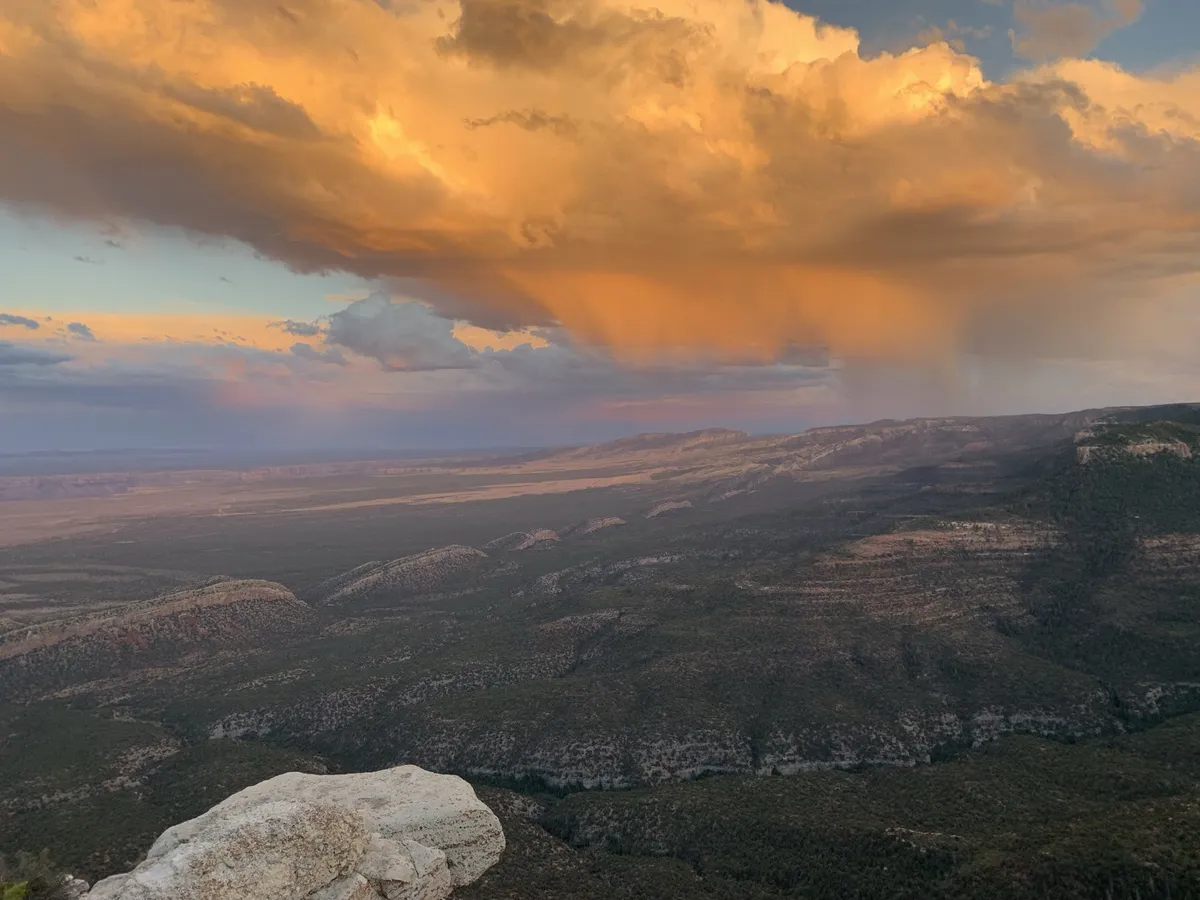
The metal end of the transect tape clacked into place and the handle jerked to an abrupt stop as the sun began to descend behind the trees, sending long spears of shadow across the meadow in front of me. It had just taken me and a fellow graduate student most of a day to complete one site, and I could hear the uncertainty below the surface of Tyler’s voice as he asked how many plots, exactly, did I plan to survey over the next month and a half? That morning I had been buoyed by months of preparation for this moment – coordinating with the grazing permittee, doing practice runs of the vegetation and soil sampling protocol in the forest behind my house, making data sheets and poring over plant lists, preparing maps. Now, as we jostled down the road to find camp, I reassured him that we would get faster while privately wondering if I was insane.
Over the next couple months, we did in fact get faster, fast enough to collect a wealth of data that carried me through the completion of my master’s thesis. The experience was not without its challenges. An exceptional monsoon year meant plenty of lightning, washed out roads, and flooded highways. I was thoroughly humbled by the plants of the Kaibab Plateau (an accurate introduction to botany, as it turns out), and Tyler learned how fast you can get a sunburn at 9,000 ft elevation (to anyone else considering shorts up there: the answer is very fast). It all felt worth it by the time I was delivering my defense presentation, but thanks to the incredibly talented scientists on my committee, the work I did that summer didn’t end there. With additional analysis, data visualization, writing, editing, and perseverance through revision cycles from Dr. Clare Aslan, Dr. Sara Souther, Dr. Karen Haubensak, and Dr. Collin VanBuren, we are celebrating the recent publication of “Changes in Pollinator Resources Over Time in a High-Elevation Rangeland Under Interacting Drought Stress and Variable Livestock Grazing” in Rangeland Ecology & Management.
If you’ve never really considered the impact of land management decisions on pollinators or pollinator habitat, you are far from alone. However, growing documentation of worldwide declines in pollinator populations, combined with recognition of the fundamental and critical ecosystem services they provide, is starting to focus more attention on sustaining pollinators through threats such as climate change, pesticide use, and disease. What does that have to do with a grazing permit on the Kaibab Plateau? Well, that’s essentially what our study addresses – what does livestock grazing on the Kaibab Plateau have to do with pollinators, specifically their forage resources (better known as flowers) and nesting habitat? Using the vegetation and soils data collected in 2022 for my thesis, and a matching dataset collected in 2005/2007 as a baseline assessment of conditions across the USFS grazing allotment that covers the Kaibab Plateau, we investigated how measures of pollinator forage and nesting resources differed between time periods and grazing status, focusing on sites in grassland and pinyon-juniper woodland vegetation types.
The grazing permit for this allotment is held by an environmental non-profit, and as a result the stocking rate is far below that of commercial ranching operations, pastures are grazed on a rest-rotation system, and some pastures have been closed to grazing for a relatively long time. Luckily for us, these practices resulted in a de facto division between grazed (actively used pastures) and ungrazed (pastures that had been historically grazed, but rested for at least 13 years at the time of the study). Still, any ecological investigation in a natural system will face less-than-ideal conditions from a scientific perspective, and ours was no exception. Most notably, there was a substantial difference in elevation between grazed grassland sites and ungrazed grassland sites simply because of the location of grazed and ungrazed pastures. This meant that within the grassland vegetation type, it was impossible to disentangle the effects of grazing and elevation from each other. To address this shortcoming, we did additional analyses on a subset of grassland sites that were spatially consolidated at high elevation but varied in visible cattle sign, essentially creating a dataset where grazing pressure still varied but elevation did not. The results of the additional analyses were similar to those using all grassland sites, indicating to us that differences between grazed and ungrazed sites were not due to elevation alone.
So, what were those differences? What can we say about the impact of livestock grazing on pollinator foraging and nesting resources? I’ve never been accused of under-analyzing, so I’ll leave it to the reader to peruse the full results section, but I will share some key findings. The most stark and obvious trend we found was a significant decline in forb species diversity over time, across both vegetation types and grazing statuses. Such a consistent decline independent of grazing or vegetation community points to the effects of climate change. However, we did find some significant changes in grassland vegetation communities related to grazing, and in high-elevation grassland forb communities related to visible cattle sign. There were also significant differences in soil compaction and woody litter based on grazing status at grassland sites, which could impact pollinator nesting habitat. Finally, the variation in many of our findings is an important reminder that this is not a simple question – plant-pollinator networks, forb communities, and soils all have intricacies of their own, let alone in relation to each other and to grazing.
There are significant limitations to interpreting results for a landscape shaped by many interconnected forces – a long history of varying grazing practices, the evolving effects of climate change, and although we did not address it in this paper, I would be remiss if I didn’t say rapidly intensifying fire regimes. Nevertheless, our results suggest that both climate and grazing are likely influencing pollinator resources on the Kaibab Plateau. Climate projections indicate continued stress on plants and the potential for continued decreases in quantity and quality of floral resources. The fact that we did find evidence that grazing may result in changes to pollinator resources, even at very low stocking levels, suggests that this topic is well worth further investigation to ensure grazing does not negatively impact pollinators when they are already facing significant climate-related challenges. The complexity of this topic is important too – the ultimate consequence of changes to the delicate relationship between pollinators and their ecosystem is difficult to predict, and in that context, land management practices that are conservative and prioritize pollinators would be wise.
Given the ubiquity of livestock grazing on public lands and the fraught politics surrounding it, more data on the impact of grazing on pollinator resources in general is crucial, especially in a wider range of systems and including different grazing practices. Further research that refines our understanding of where, when, how, and why grazing affects pollinators can support the development of consistent, evidence-based best management practices for livestock grazing to support pollinator conservation. In the meantime, there is existing evidence for grazing practices that could help protect pollinators, such as maintaining habitat heterogeneity, timing grazing to minimize impacts on pollinator forage, managing stocking levels based on utilization rates, and monitoring impacts to pollinator habitat.